 Back to the Computer Zoo
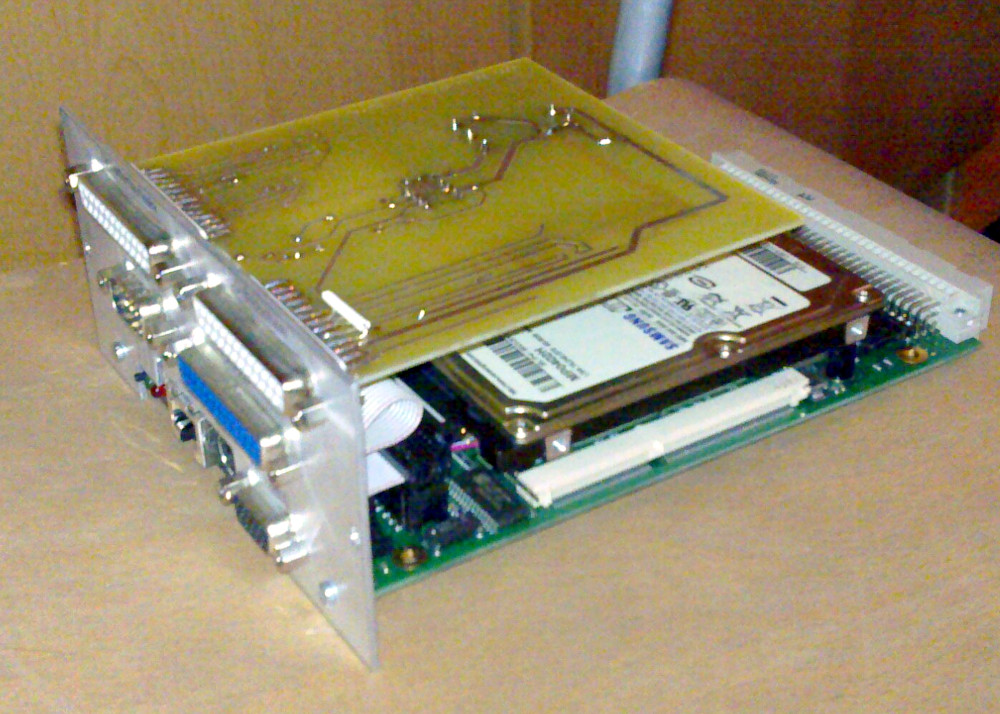
This is the CPU module, removed from the chassis. Altough the whole thing is 3 HE tall, the actual magic is contained to a single PCB. Most of the height stems from the plethora of connectors and the laptop HDD screwed onto the board, above the actual CPU with some spaces in between. The top board is some kind of "home made" adapter board.
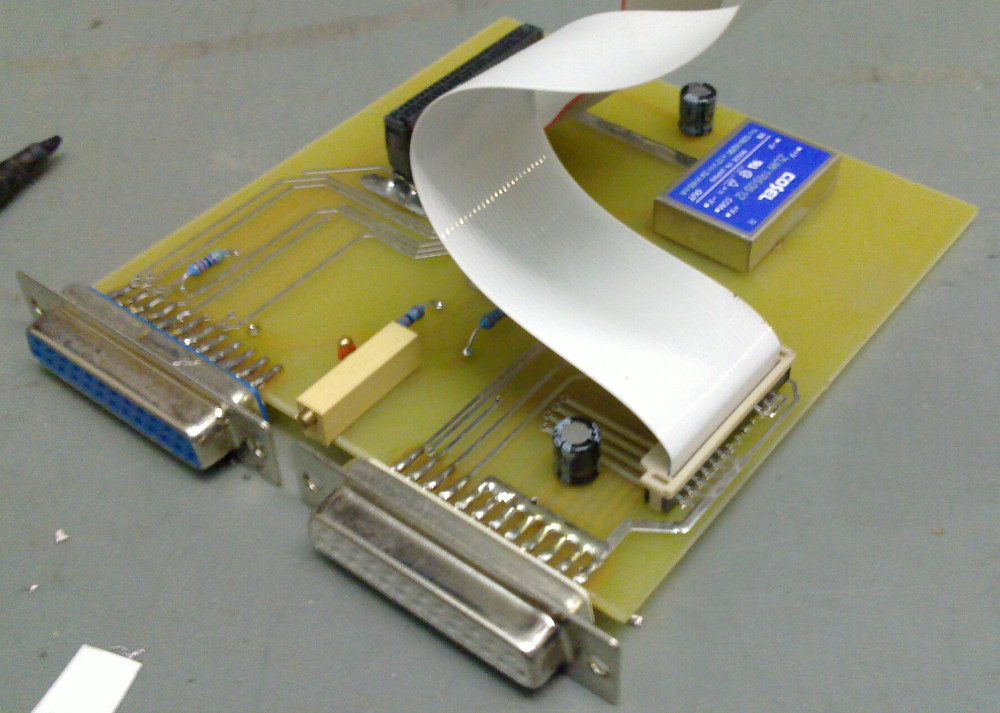
This is the adapter board on its own (removed from a different PC, hence the one connector that has a different color).
Unlike the CPU board, this one is of a very different build quality, probably made in a small in-house production. It looks like the PCBs we used to make in our schools photo lab: simple FR4 board with copper and photo sensitive coating on both sides, exposed to transparent film, developed, etched and finally through a solder bath. Blind vias only.
The two DB-25 connectors are labeled "floppy" and "display", no idea what signalling that is supposed to be tough? There is a contrast potentiometer here, some passives, an integrated DC-DC converted and ribbon cables to the CPU board.
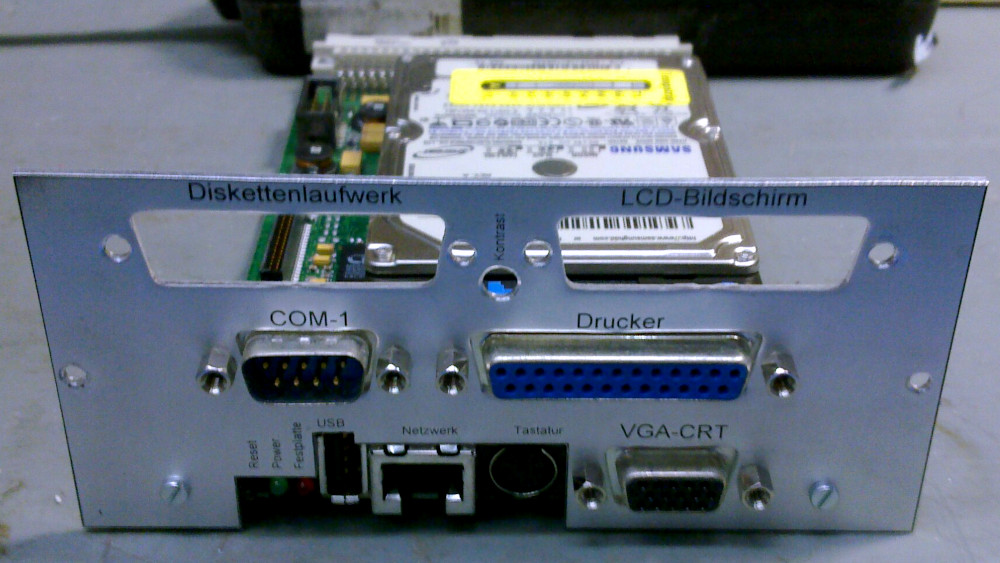
The CPU module from the front, besides the DB-25 connectors from the "home made" adapter PCB, there is a standard parallel port, PC serial port, VGA, PS/2 keyboard, Ethernet, USB and a couple status LEDs.
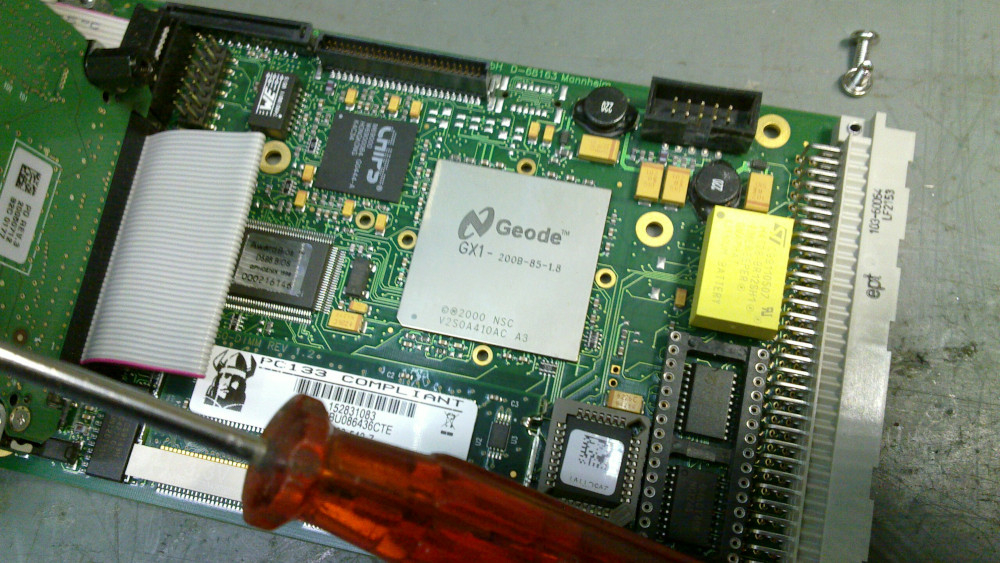
Un-screwing and lifting the hard drive, we can see the CPU: A 200 MHz Geode GX1 SoC, a Pentium MMX compatible embedded CPU.
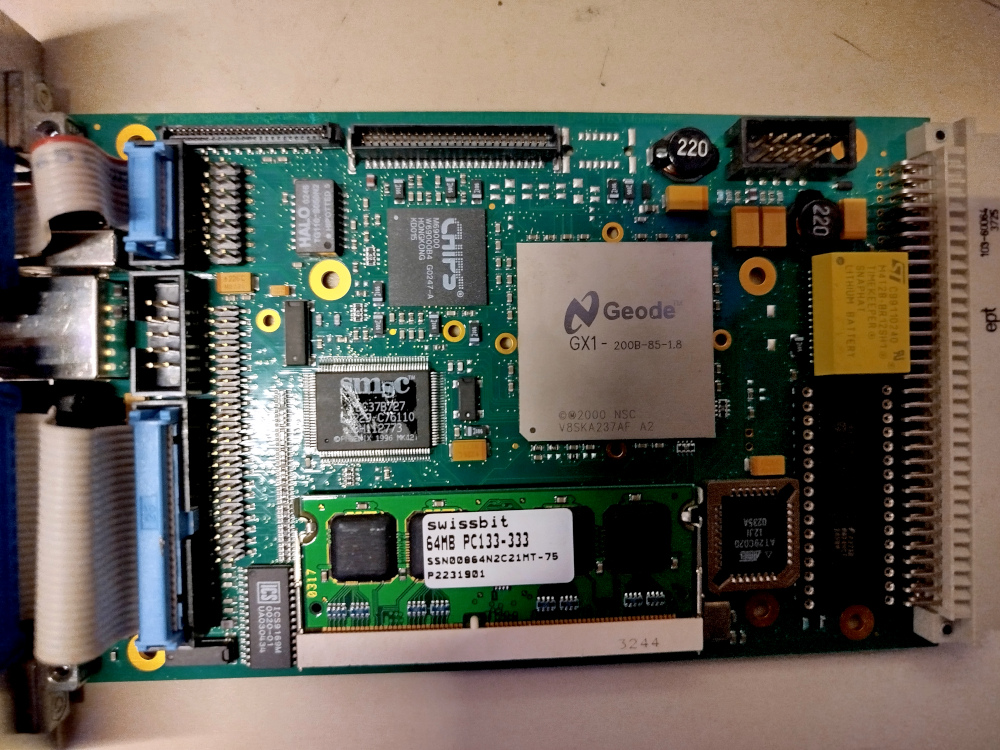
A somewhat clearer photo of yet another different module with the HDD removed entirely and the stickers peeled off. On the right side of the image is the 96 pin DIN41612 connector.
Next to the CPU, we can see a 64M laptop RAM stick, BIOS ROM, the yellow brick is an RTC with built in battery.
The CHIPS M69000 is a graphics accallerator with 2M VRAM integrated.
Underneath the Award/Phoenix stickers, there is an FDC37B727 hiding out, a generic super I/O controller (floppy controller, 16550 compatible UARTs, parallel port, all in one).
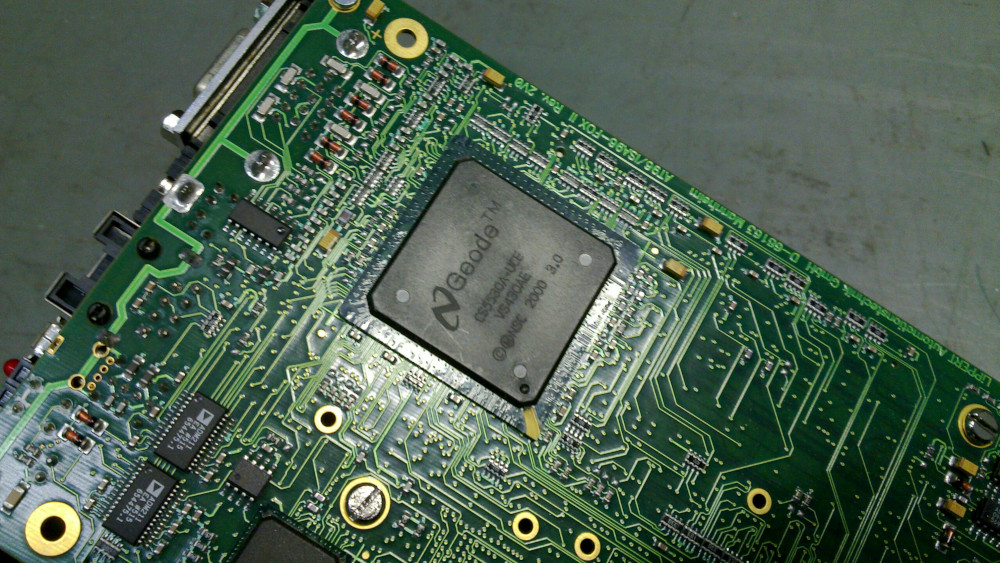
On the bottom side of the PCB is the companion chip for the Geode CPU, a CS5530A chipset controller, and (cut-off at the bottom of the image) an Intel 82559 PCI Ethernet controller, driving the LAN port.
 Back to top Back to top
|
| |
Back to the Computer Zoo
|